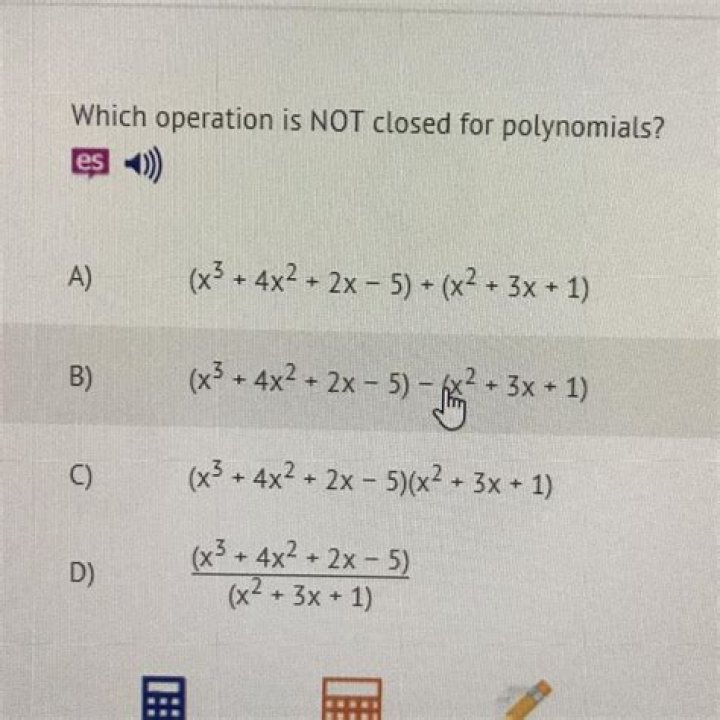
A set is closed (under an operation) if and only if the operation on any two elements of the set produces another element of the same set. If the operation produces even one element outside of the set, the operation is not closed.
What operations form closed polynomials?
Understand that polynomials form a system analogous to the integers, namely, they are closed under the operations of addition, subtraction, and multiplication; add, subtract, and multiply polynomials.
Are polynomials closed under division?
Polynomials are not closed under division. When you divide polynomials it is possible to get quotients with negative exponents or with fractions that have exponents in the denominator, and neither of these could be included in polynomials.
What is closed operation?
Simply a set is said to be closed under an operation if conducting that operation on members of the set always yields a member of that set. For example, the positive integers are not closed under subtraction, but are under addition: 1 − 2 is not a positive integer despite both 1 and 2 are positive integers.
Which is not closed under the operation addition?
Whole numbers are not closed under operation A Addition class 9 maths CBSE.
What is not a polynomial?
Polynomials cannot contain fractional exponents. Terms containing fractional exponents (such as 3x+2y1/2-1) are not considered polynomials. Polynomials cannot contain radicals. For example, 2y2 +√3x + 4 is not a polynomial.
What is the closure property polynomials?
Closure Property: When something is closed, the output will be the same type of object as the inputs. For instance, adding two integers will output an integer. Adding two polynomials will output a polynomial. Addition, subtraction, and multiplication of integers and polynomials are closed operations.
Are integers closed under subtraction?
The operation we used was subtraction. If the operation on any two numbers in the set produces a number which is in the set, we have closure. We found that the set of whole numbers is not closed under subtraction, but the set of integers is closed under subtraction.
Which example proves that integers are not closed under division?
The set of integers is not closed under the operation of division because when you divide one integer by another, you don’t always get another integer as the answer. For example, 4 and 9 are both integers, but 4 ÷ 9 = 4/9.
How are polynomials closed under multiplication?
Polynomials are always closed under multiplication. Unlike with addition and subtraction, both the coefficients and exponents can change. The variables and coefficients will automatically fit in a polynomial. When there are exponents in a multiplication problem, they are added, so they will also fit in a polynomial.
What operations are not integers closed?
b) The set of integers is not closed under the operation of division because when you divide one integer by another, you don’t always get another integer as the answer.
Which of the following sets is not closed under subtraction?
Answer: The set that is not closed under subtraction is b) Z. A set closed means that the operation can be performed with all of the integers, and the resulting answer will always be an integer.
Which operations is the following set closed under?
The set { , -3, -1, 1, 3, } is closed under the operation of multiplication. The given set is a set of odd numbers. We know that any odd number when multiplied by another odd number gives an odd number.
Which of the following binary operation is not closed?
Addition, subtraction, multiplication, and division are binary operations. The set S is said to be closed under the operation if the product always lies in S itself. The positive integers are not closed under subtraction or division. The operation is called associative if we always have (a ∘ b) ∘ c = a ∘ (b ∘ c).
Under which operation natural number is not closed?
Hence, the set of natural numbers is not closed under division. Hence, we can say that the set of natural numbers is closed under addition and multiplication but not under subtraction and division.
Which is not closed under multiplication?
Natural numbers are not closed under multiplication.